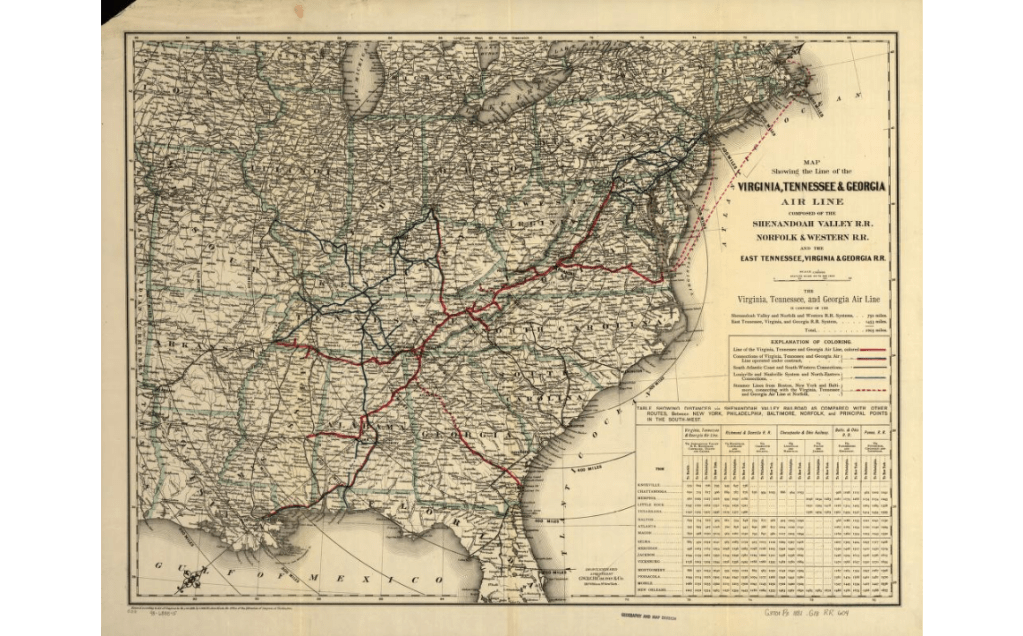
1865 saw the end of the Civil War, the first assassination of a sitting President, the beginnings of reconstruction and a healing of the nation. An interesting aspect of this time, affecting economics, industries, and large-scale politics, was the mass exodus of newly freed African American slaves and poor whites as they attempted to start anew outside of the Jim Crow South. Many innovations contributed to the success of the mass migrations of these former slaves to the Western territories; these travelers will be called “Exodusters.” [1]
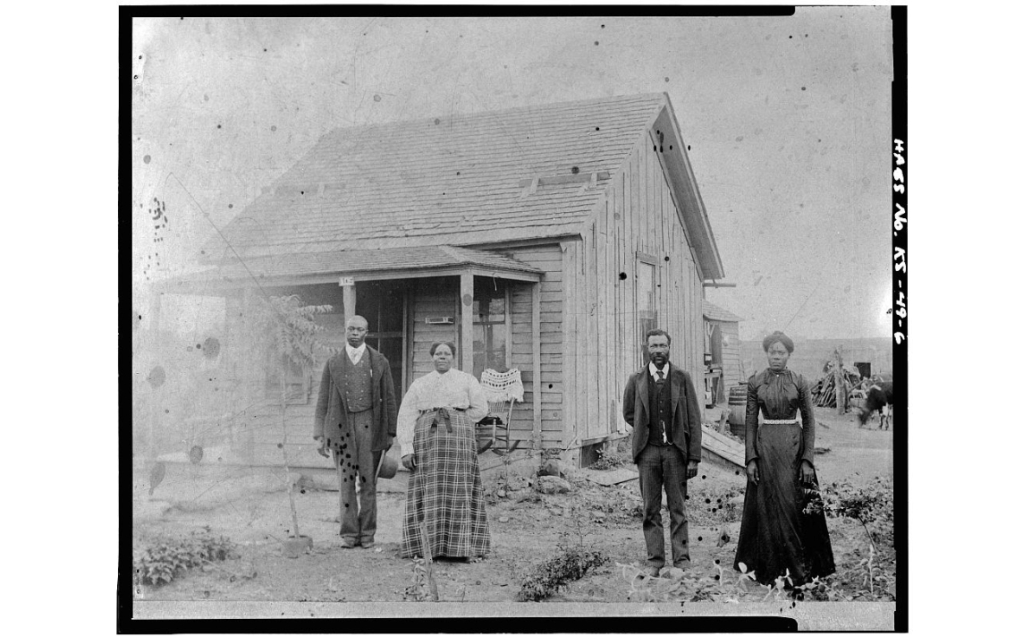
Photo of “Exoduster” Homestead-https://www.loc.gov/resource/hhh.ks0077.photos/?sp=6
A key innovation and implementation were the quick building of railroads focusing on western expansion specifically to the Kansas territory. As the Railroad grew so did the cities they traveled through, bringing people materials to areas defined as rural and sparsely populated. Donaldson and Hornbeck, in their evaluation of the economic impact of the railroad’s points to a distinct cause and effect, stating as the railroads grew so did the U.S. economy. [2] One sees greater impact of these movements when looking at the quick growth of Kansas City, Kansas. In 1886, a commerce publication shows a deliberate and steady increase in both populations and value of property and business in Kansas City. Published by S. Ferd Howe, it details the growth experienced including alarming figures that the valuation increased from 500,000,00 to 750,000,000 in a short 5 years. He connects this squarely on the expansion of the “magnificent railroad system.” [3] Additionally, the population saw marked growth’ demonstrating the mass exodus didn’t just pass through Kansas, but many found permanent homes in the territory. The U.S. Census bears this out by showing that the population was at 106,000 in 1860 but ballooned up to over 900,000 by 1880. [4] It should be noted that in 1886 Kansas City boasted the majority of this population being the central point for railroad interconnections.
Surprisingly, evidence shows that while the mass exodus did occur, the rotational effect of populations meant areas such as South Carolina and Louisiana had virtually no growth, they also did not decrease their overall populations. Assisted in this is the virtual dependence of “King Cotton” which required people to work the fields and transport from the plantations from Southern ports (410,000 bales in 1879 alone). Such economic progress in the face of Civil War reconstruction prompted the necessity of Railroad connections. This attitude was also helped by an intentional turn for Charlston specifically to become an industrial transport on the East Coast.[5] This data indicates that the while the South lost much during the war, it gained enough in people and immigrants moving from the North to replenish the population. The loss of property and damage to crops took longer to recover, however by the time 1900 Charleston was once again a thriving coastal town.
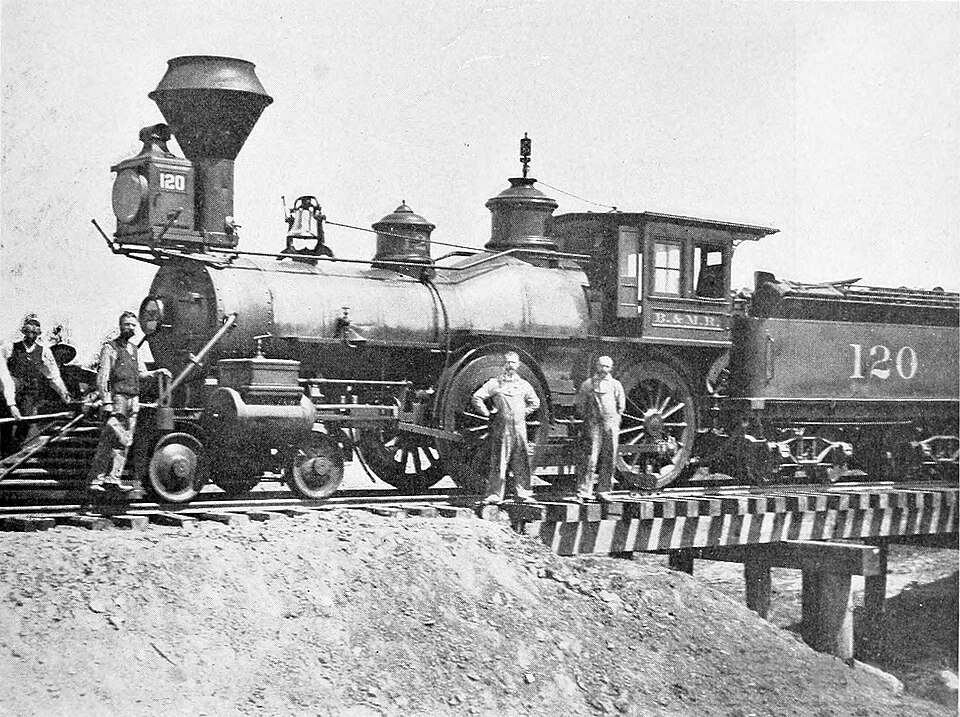
However, what was good for the goose was not necessarily good for the gander. As the railroad expansion moved west, some in the South and East felt left behind. In Kentucky; advocates against railroad expansion were seen as the old land gentry class, holding on to ideals protecting the status quo while their opponents used a type of “prosperity gospel” intent on promoting only the highest benefits for all involved. Another argument made was the fear experienced by locals as smaller rail lines were being absorbed into larger entities owned and managed by outside companies. In Bourbon County specifically, referendums would be brought forth and voted on over the course of decades as farmers pushed back on the “progress” touted. Additionally, the issue over economics and funding became a hot bed issue for politicians to point fingers and sway voters. Ultimately, much money was spent on building railroad infrastructure in Kentucky; the companies went bankrupt or were absorbed into larger regional entities proving in some minds that the railroad expansion was merely dangerous disruption.[6]
In conclusion, the end of the Civil War ushered in a new focus of recovery and prosperity opportunities. Spurred by the completion of railroads connecting the West and Southern states, people began to see the West as a physical goal and not a distant destination. These rails encouraged people to take brave steps into unknown territories and established shifts in thinking fighting against the established norms of plantation life. The Railroad expansions provided a source of transportation for refugees and economic security for cities where the trains stopped. Even when faced with business failures and political blockades, the railroads moved forward to the West bringing economic progress and new lands to escape old lives. These changes were crucial in propelling America into the next century and helped the country become a global powerhouse of import and export.
[1] “Exodusters & Western Expansion” National Archives, date modified July 12 2022, https://www.archives.gov/research/african-americans/migrations/exodusters
[2] Donaldson, Dave, and Richard Hornbeck. “Railroads and American Economic Growth: a ‘Market Access’ Approach.” The Quarterly Journal of Economics 131, no. 2 (2016): 799–858. https://www.jstor.org/stable/26372653.
[3] S. Ferd Howe, The Commerce of Kansas City in 1886 With a General Review of its Business Progress, 1886, accesses 25 May, 2026, Internet Archives,9-11. https://ia601305.us.archive.org/6/items/commerceofkansas00howe/commerceofkansas00howe.pdf
[4] United States Census 1880, accessed 26 May, 2026, 3. https://www2.census.gov/library/publications/decennial/1880/vol-01-population/1880_v1-07.pdf p3.
[5] Chamber of Commerce “Charleston, South Carolina : the advantages of the city of Charleston as a port of import and export, for the trade and commerce of the northwestern states of the United States, and of Central and South America, the West Indies, and Europe : the report of a special committee of the Chamber of Commerce, presented and adopted March 29, 1880” https://babel.hathitrust.org/cgi/pt?id=loc.ark:/13960/t78s50x9g&seq=1
[6] Davis, Charles L. “The Railroad Expansion Controversy in Postbellum Bourbon County: Conflicting Economic Interests and Ideological Perspectives Among Urban and Rural Elites.” The Register of the Kentucky Historical Society 112, no. 1 (2014): 51–82. http://www.jstor.org/stable/24641120.
Press Esc to exit editor.SettingsBanner


Leave a Reply