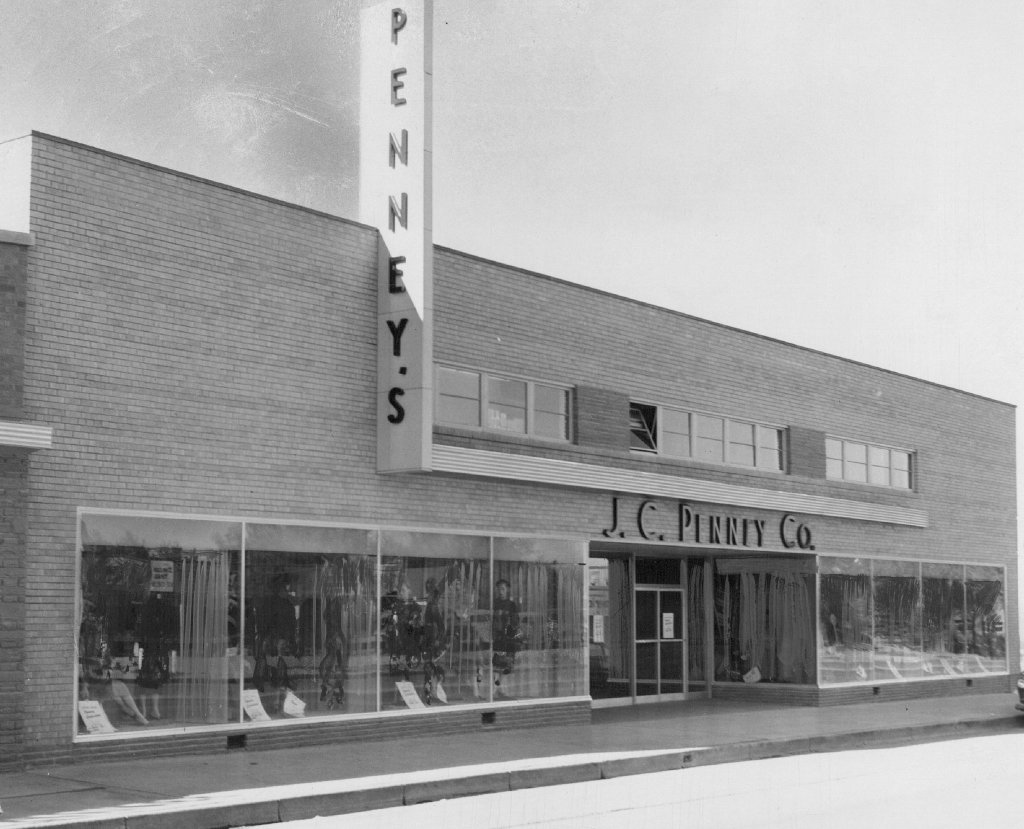
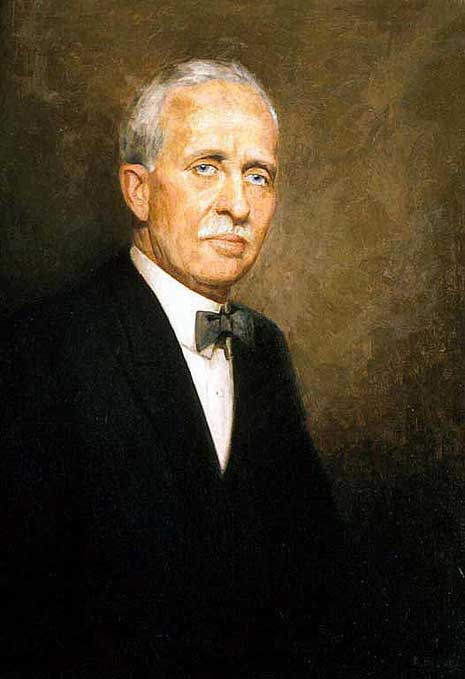
 James Cash (J.C.) Penney was an entrepreneur, businessman and philanthropist in the early 20th century. He was born to humble parents in Missouri in 1875, growing up he learned the value of working hard. A quick study; he soon proved to be adept at retail. Additionally, his parents encouraged a strong and honest work ethic, a character trait that would serve him well, guiding his directions away form other, less honorable, business practices (Penney, 39). In his early teens he was diagnosed with stress and susceptible to tuberculosis (consumption), forcing him to move to drier climates and relocating to Denver to try his fortunes there. With his business venture struggling in Denver, he chose to make other arrangements.
Picture of Golden Rule Store 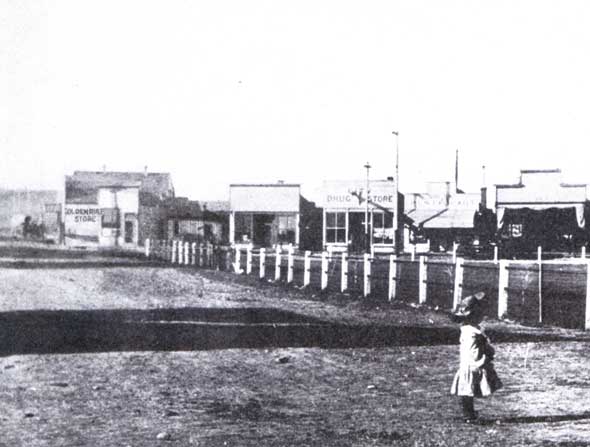
Partnering with his spouse; he chose to open a new business in the small mining town Kemmerer Wyoming, where he was successful in running a “revolutionary” cash business, which was, according to him, due to the low overhead of just him and his wife running the store (Dorsey, 556). His small successes led to further advancements, and soon he began to open other stores titled “The Golden Rule”. This labeling of his and his partner, Guy Johnsotn’s storefront was more than a gimmick it was a way in which Penney chose to conduct his business. In fact, during these early years, he was “haunted” by a deep yearning in his heart to place the Golden Rule concept into practice (Penney, 86). In 1909 he opened an office in Utah where this unique business technique started to develop. Penny bought out his partner’s interest in the growing stores and changed the name of his business ventures to his namesake in 1913. Penney’s ethics made him a different type of entrepreneur and boss. He maintained a level of customer service unmatched in the retail world at the time. In a period where urban cities had their “fancy” department stores and rural communities had other retailers, specifically SEARS & Roebuck, which focused on a mail order catalog business model; J.C. Penney’s methods of honest in person shopping flourished as a quasi-middle ground option.
By 1927 Penney was a successful merchant, having 887 stores in all but 4 states at the time. This expansion of stores also meant an expansion of money and his annual sales surpassed 100M (E.C. Sams). The success of his retail business allowed Penney to explore his other passions such as agriculture and cattle farming. In 1922 he acquired a large farm in order to improve the quality of cattle for American consumption; continuing to apply his own personal standards of principle and integrity to work with (Penney 122-123). One of the more unique ideas he put into practice was a shared farming system in Florida. The goal was to produce over 6000 farms in small parcels to assist men in theses agricultural activities (Dorsey 560). Interestingly, and in difference to the feudal system of Europe, after a year the chosen farmers were offered the ability to purchase the farms they currently worked on. This proved to be an interesting way for Penney to earn an investment and help settlers as sadly; the farms were not to be successful.
Tragically, it was not all success, in 1910 he suffered a personal loss; his first wife died unexpectedly, leaving him a widower and single parent of two sons. The experiment in the Penney farms produced (no pun intended) bitter results, as Penney learned that simply throwing money around could not guarantee successful ventures. Sadly, the farm project was sold to a company that used the soil intended for this purpose. Then in 1923 his second wife would die. Through these difficult circumstances, Penney continued to be a strong force in the economic and retail world.
Through his mourning in the early 1910’s Penney discovered his philanthropic calling and began to support the local bowery mission in NYC; donating approximately 4 million dollars in pre-depression monies (Toney Carnes). These donations continued even in the face of the Great depression. He also continued to support worthy causes outside retail; building a reputation and enterprise that put people before profits. His philanthropic interests would continue and the JCPenney foundation continues to support several charities. Also, his personal life picked up and he would marry his third wife in 1926; which would last until his death in 1971. His success was built on the same ethics instilled in him since childhood; his faith and humility kept him grounded and focused on the personal and a customer focused approach to business; which made JCPenney a popular store to both shop and work.
Works Cited:
Carnes, Tony. James Cash Penney: Leader and Benefactor through the Depression. The Bowry Mission. ND. https://www.bowery.org/timeline/our-stories/jc/
Dorsey. C.P. Missouri Historical Review, Volume 021 Issue 4, July 1927, “Missourians abroad” https://digital.shsmo.org/digital/collection/mhr/id/9753
Penney, J.C. Fifty Years with the Golden Rule. New York: Harper & Brothers, 1950. https://archive.org/details/fiftyyearswithgo0000unse_h1v2
Reese, Anna Alice and Trout, Caroline. JCPenney, Biography. State Historic Society of Missouri. https://historicmissourians.shsmo.org/j-c-penney
Sams, E.C. JC Penny Company Annual Reports. 1927. New York, 03 March, 1928. https://archive.org/details/jcpenneyannualreports/jcpenney1927/page/n1/mode/2up
Smithsonian Institute-Portrait gallery, JCPenney. https://npg.si.edu/blog/james-cash-penney-1876%E2%80%931971
 redbeardedhistory
Leave a comment