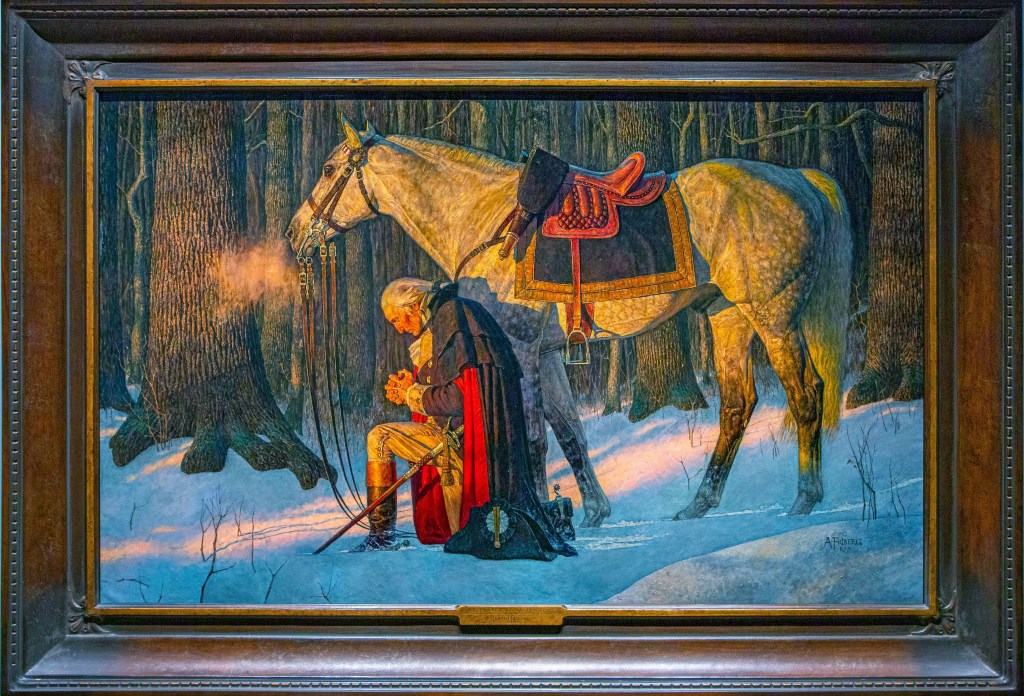
There is a well-known painting of George Washington kneeling in the snow, the title is ” The Prayer at Valley Forge” and was created by artist Arnold Friberg for the celebration of America’s Bicentennial.[1] As you can see below, it depicts our first General in a pose of humble submission, eyes closed and hat off, kneeling in a moment of meditation and prayer. His horse stands next to him, waiting patiently for his master to finish speaking with God Almighty. 50 years later the image still evokes a reverence for civic leadership, which is rarely seen outside our shores. The question is Why? What in our collective psyche calls us to Christ? Why when in our darkest hour, we turn to a faith that struggles for public relevance, and yet is one of the ways we as a society judge who is fit to hold office? Looking for some historical context, I turn to the record of our nation shortly after the Revolution when our leaders were establishing procedures and protocols for government.
In 1833 Reverand Jasper Adams gave a sermon espousing the very ideals of Christianity in America. In fact, he delivered word upon word of how the very foundation of American government was found in the basis of Christianity. He reminded his parishioners that the earliest settlers in Rhode Island Charter intended to the “serious and religious intentions of edifying themselves and one another…” Such intentions carried on through the 1600’s and into the early days of the Revolution. Indeed, the concepts of freedom and justice a pervasive throughout the Christian ideal. Carrying for one another’s neighbor and holding to the higher standard of Justice connect directly to the lofty ideal of Christian mindedness. So ingrained is this concept that many State Constitutions recognize the fact that Christianity is the “foundation for civil, legal, and political institutions.”[2] Furthermore, the idea that we are a Chrisitan nation and therefore need not to establish a national religion intends the concept to be a personal inworking that then will spill out to the civic Liberties that we enjoy. It is this free will that is unique among Protestant Christians (the freedom to choose who we worship) that translated to a uniquely American freedom we enjoy today.
I find it most interesting that even in the early days of our Constitution, it became imperative that Congress not instill barriers to religious expression, and yet our Christian core beliefs were, and are being followed. Oaths on the Bible and, as Adams points out, legal requirement be respectful to observe Sundays are inherently Christian values that at the time were mandated through State law.[3] Adams goes so far in his sermon to state that at least twenty-three of the states recognize the religious authority of Sunday.[4] Adams is correct in insisting that the founders would wish our philosophy to continue in this manner. I submit that the very nature of values, lies not with the disagreement between Protestant and Catholic, but between Christian and Secular leanings. It is the Christian ethic that values truth and that “Truth shall make you free”.[5] Jasper Adams’ sermon provides one example of many that as the country was growing and the world was changing there was a desire to maintain a connection to the core values that strengthened those fighting for freedoms and formed a nation out of rebellion.
[1] Arnold Friberg, The Prayer at Valley Forge, 1975, oil on canvas, Museum of the Bible, https://www.museumofthebible.org/prayer-valley-forge-fiftieth.
[2] Jasper Adams, St. Michael’s Episcopal Church, and Episcopal Church. Diocese of South Carolina. Convention Charleston, S.C. The relation of Christianity to civil government in the United States : a sermon preached in St. Michael’s Church, Charleston, February 13th, 1833, before the convention of the Protestant Episcopal Church of the Diocese of South-Carolina: Charleston [S.C.]: Printed by A.E. Miller, 1833. Sabin Americana: History of the Americas, 1500-1926 (accessed February 8, 2026) 11 https://link.gale.com/apps/doc/CY0102787302/SABN?u=vic_liberty&sid=bookmark-SABN&xid=56b30359&pg=11.
[3] Ibid, 14.
[4] Ibid
[5] John 8:32


Leave a Reply